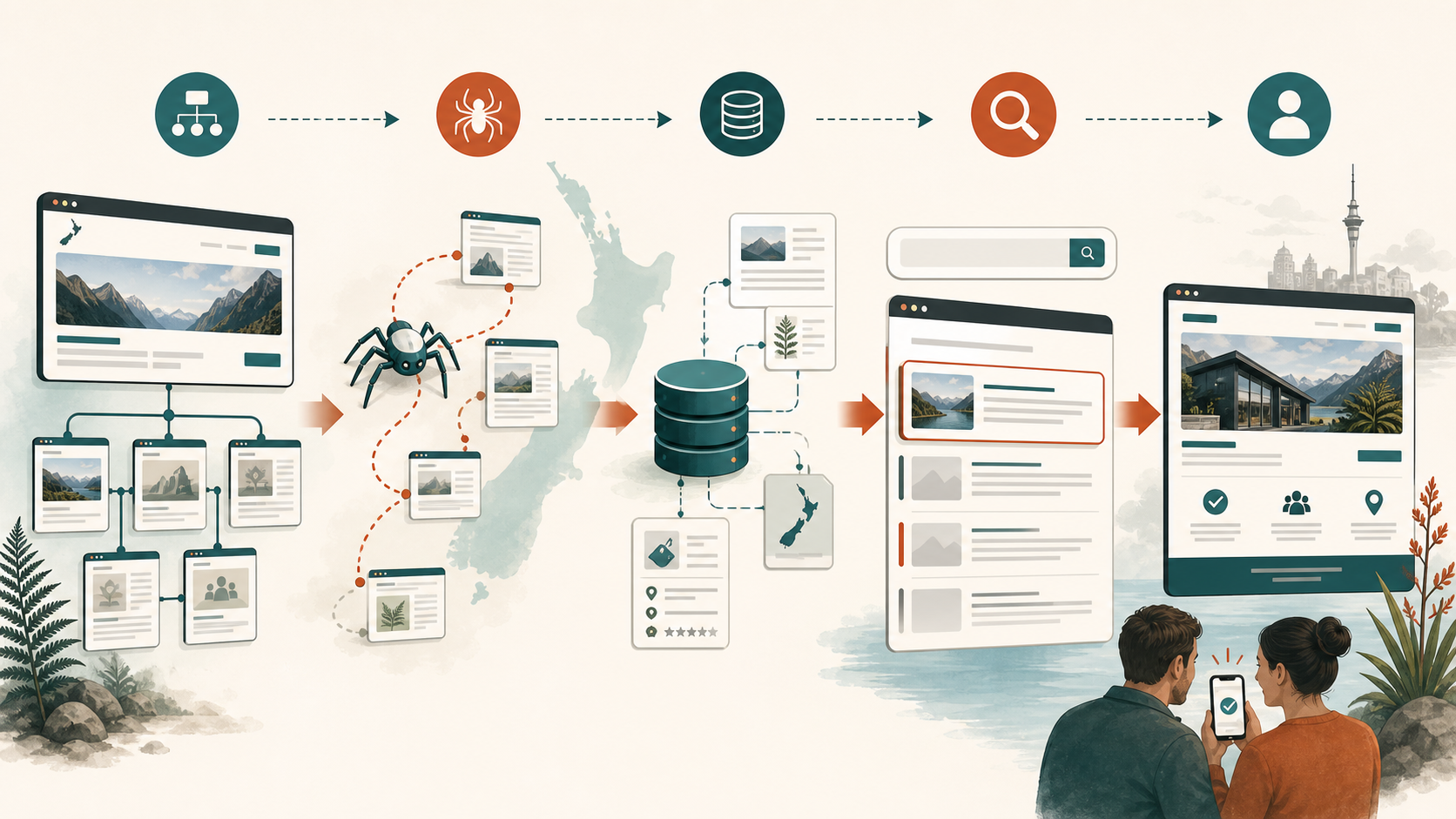
SEO helps search engines understand your website and helps the right people discover it when they need what you offer. It is not a bag of secret tricks or a guarantee of first place; it is coordinated work across content, structure, technical access, reputation and customer experience.
A page must be discoverable, indexable, relevant, credible and useful. Rankings create an opportunity, but the page and business still need to earn the enquiry.
Crawling and discovery
Search engines use automated crawlers to follow links and find pages. Internal links, external references and sitemaps can help discovery. Important content should be available through normal links rather than hidden behind interactions a crawler or user cannot reach.
Crawling does not guarantee indexing or ranking. It simply allows a search system to fetch and evaluate the page.
Indexing and canonical pages
During indexing, a search engine interprets the main content, titles, links, images and other signals. Duplicate or very similar URLs can create confusion, so sites should use redirects or canonical signals to identify the preferred version where appropriate.
Technical blocks, server errors, inaccessible resources and weak site structure can prevent good content from being processed properly.
Search intent and relevance
Intent is the job behind a query. “How does heat-pump servicing work?” asks for education; “heat-pump service Wellington” suggests a local commercial need. A strong page matches the question, level of detail and next step instead of forcing one sales page to rank for everything.
Topical coverage means answering the important subquestions naturally. It does not mean repeating keywords or producing dozens of near-identical pages.
Internal links, reputation and technical quality
Internal links show how services, locations, guides and evidence relate. External links and mentions can support reputation when they arise from genuine partnerships, useful resources and real business activity—not manufactured link schemes.
Mobile usability, speed, security, stable layout and accessible HTML contribute to a good overall experience. Technical SEO creates the conditions for content to perform; it cannot make an irrelevant offer useful.
Local SEO and what happens after the click
Local visibility relies on accurate business information, relevant local pages, reviews, map listings and evidence that the business serves the area. Keep names, contact details, categories and opening information consistent.
After a visitor arrives, clear answers, trust signals, examples, pricing context where appropriate and an obvious action determine whether visibility becomes a lead. Measure enquiries and qualified outcomes, not traffic alone.
Timing, control and a first 90 days
SEO changes can take time to be recrawled and assessed. No provider controls rankings, competitor activity or how a search engine presents every result. A responsible provider can control research, technical work, content quality, measurement and iteration.
Days 1–30: fix access, tracking and critical page issues. Days 31–60: improve important commercial pages and site structure. Days 61–90: publish genuinely useful supporting content, strengthen local evidence and review early query and enquiry data.
Query-to-enquiry explorer
Search
Can the right audience express the need? Failure at this stage breaks the commercial chain even if every earlier stage worked.
Results
Does the title clearly match that need? Failure at this stage breaks the commercial chain even if every earlier stage worked.
Page
Can search engines and users access the answer? Failure at this stage breaks the commercial chain even if every earlier stage worked.
Useful answer
Does the content resolve the question? Failure at this stage breaks the commercial chain even if every earlier stage worked.
Trust
Is there evidence the business can deliver? Failure at this stage breaks the commercial chain even if every earlier stage worked.
Action
Is the next step clear and proportionate? Failure at this stage breaks the commercial chain even if every earlier stage worked.
Frequently asked questions
How long does SEO take?
There is no fixed period. Search engines need to discover and reassess changes, while competition, site history and the type of query all matter. Some technical fixes can be reflected quickly; meaningful commercial improvement often requires months of coordinated work and iteration. Ask for leading indicators and avoid guaranteed dates.
Can a business pay Google for an organic ranking?
Paid search advertising can buy ad placement, but it does not purchase organic rankings. Organic visibility is determined by search systems. A provider can improve accessibility, relevance, usefulness and reputation, but cannot control the final position for every query.
Are keywords still important?
The language customers use remains useful for research and page design. Keyword repetition is not a strategy. A strong page understands the intent, covers necessary concepts, uses natural language and makes the subject clear through titles, headings and content.
Does every service need a separate page?
Important services often deserve focused pages when they answer distinct needs. Do not create separate pages merely for tiny wording or location changes without unique value. Page structure should help people navigate the offer and help search systems understand meaningful differences.
What is technical SEO?
Technical SEO covers the conditions that help search systems access, render, understand and index a site: status codes, links, canonical signals, mobile behaviour, performance, structured data and more. It supports content but cannot replace a relevant proposition or credible business.
What should an SEO report contain?
It should connect work to outcomes: important query visibility, relevant landing-page engagement, enquiries, lead quality and completed improvements. It should explain uncertainty and next actions. Large traffic totals without context can hide whether the right audience is arriving.
A sensible next step
A focused review can separate technical access problems, weak page targeting, missing evidence and conversion issues so effort goes to the right constraint.
Prepared by Tin Shed Software as practical general information. Any AI-assisted workflow should be reviewed for accuracy, privacy, security and suitability before it affects customers or business decisions.