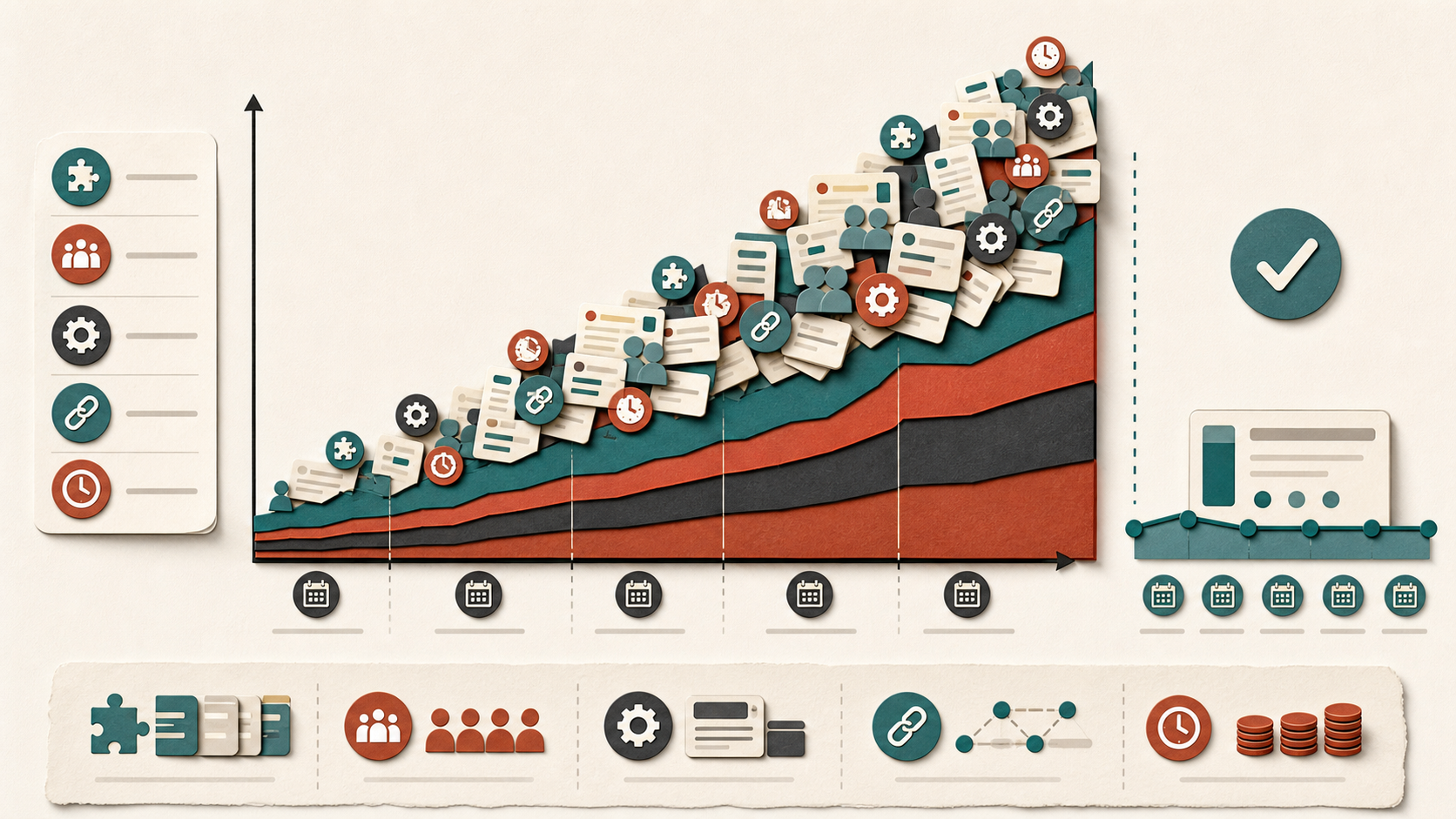
The number on a SaaS invoice is only part of the cost. A fair view includes user growth, currency, add-ons, integrations, administration, duplicated tools, manual workarounds and the future cost of leaving.
Use the calculator to expose assumptions, not to manufacture a build decision. Custom software also carries hosting, maintenance, security and improvement costs.
Monthly price versus total cost
Begin with every product used by the workflow, not only the largest contract. Record base fees, seats, usage charges, add-ons and paid integrations. Note billing currency and whether tax or foreign-exchange movement affects the actual New Zealand cost.
Separate products that could be removed from those still required under a custom or hybrid solution. Replacing one platform rarely eliminates email, payments, identity or other commodity services.
Per-user growth and price changes
Model current users, likely future users and role differences. Per-seat pricing can restrict adoption when occasional users still need visibility. Apply an explicit annual price assumption and show it in the result rather than hiding growth inside one total.
Scenarios are more useful than a single forecast. Compare flat headcount with expected growth and test a lower and higher price path.
Integration, administration and workaround costs
Include connector fees, implementation consultants, internal administration and time spent reconciling systems. For workarounds, measure a representative month: copying fields, rebuilding reports, chasing approvals and correcting errors.
Do not assume every saved hour becomes cash. State whether the benefit is released capacity, faster service, lower risk or avoided hiring.
Migration and exit costs
Review data export formats, API access, notice periods, retention and contractual assistance. Estimate data cleaning, mapping, test migrations, reconciliation, training and parallel running.
Exit cost matters even if the business stays with SaaS. It is part of dependency and should inform procurement and architecture decisions.
How to compare owned software fairly
A custom build needs discovery, design, development, testing and migration. Ongoing costs include cloud services, monitoring, backups, security work, support and planned change. Add contingency and recognise that early estimates become firmer only after discovery.
The decision may still favour SaaS—and that is a useful result. The goal is an honest operating model, not a predetermined answer.
Five-year SaaS cost calculator
Frequently asked questions
Should staff workaround time be counted as cash savings?
Only with care. Time released may improve capacity, service or resilience without reducing payroll. Label the benefit accurately and avoid multiplying every minute by a rate as if it automatically becomes cash. The calculation is still useful for comparing operational burden.
What annual SaaS price increase should be assumed?
Use contract terms and vendor history where available, then test multiple scenarios rather than claiming one forecast. Include exchange-rate exposure for overseas billing as a separate sensitivity. The objective is to understand how the decision behaves under plausible change.
How should integrations be costed?
Include connector subscriptions, consultants, internal support, monitoring and the impact of failures. Some integrations remain necessary under custom software, so classify each as removed, replaced or retained. Count only the difference between realistic future states.
What custom software costs are commonly missed?
Discovery, design, testing, migration, training, cloud services, monitoring, backups, security response, support and ongoing improvement are frequently understated. The business also needs product ownership: someone must prioritise changes and make decisions as needs evolve.
What is a break-even point?
It is the time when cumulative expected costs of two options become equal under stated assumptions. It is not a guarantee. A decision with a distant break-even may still make sense for strategic control, while a short break-even can be unattractive if delivery or migration risk is high.
Should exit costs be included if there is no plan to leave?
Yes. Data extraction, notice periods and migration constraints are part of dependency. Estimating exit effort improves procurement and helps the business preserve options. The figure can be kept as a separate scenario rather than treated as an immediate expense.
A sensible next step
Bring the assumptions behind the number. Tin Shed can help test what would remain, what could be replaced and what an owned or hybrid platform would genuinely require.
Prepared by Tin Shed Software as practical general information. Any AI-assisted workflow should be reviewed for accuracy, privacy, security and suitability before it affects customers or business decisions.